My take, History, Science and Why People Keep Coming Back
Most races have a finish line. A 24-hour race has a clock. At first glance, the difference seems almost trivial. In reality, it changes everything. There is no finish banner to chase, no set distance to conquer and no comforting thought of, “Just another 10 kilometres and I can rest.” The objective is beautifully simple: cover as much ground as possible in exactly 24 hours. Whether you’re running around a 400-metre athletics track, a park loop or a stretch of quiet road, or as I’ve recently come to learn an obstacle course loop the principle never changes. When the clock reaches 24 hours, you stop.
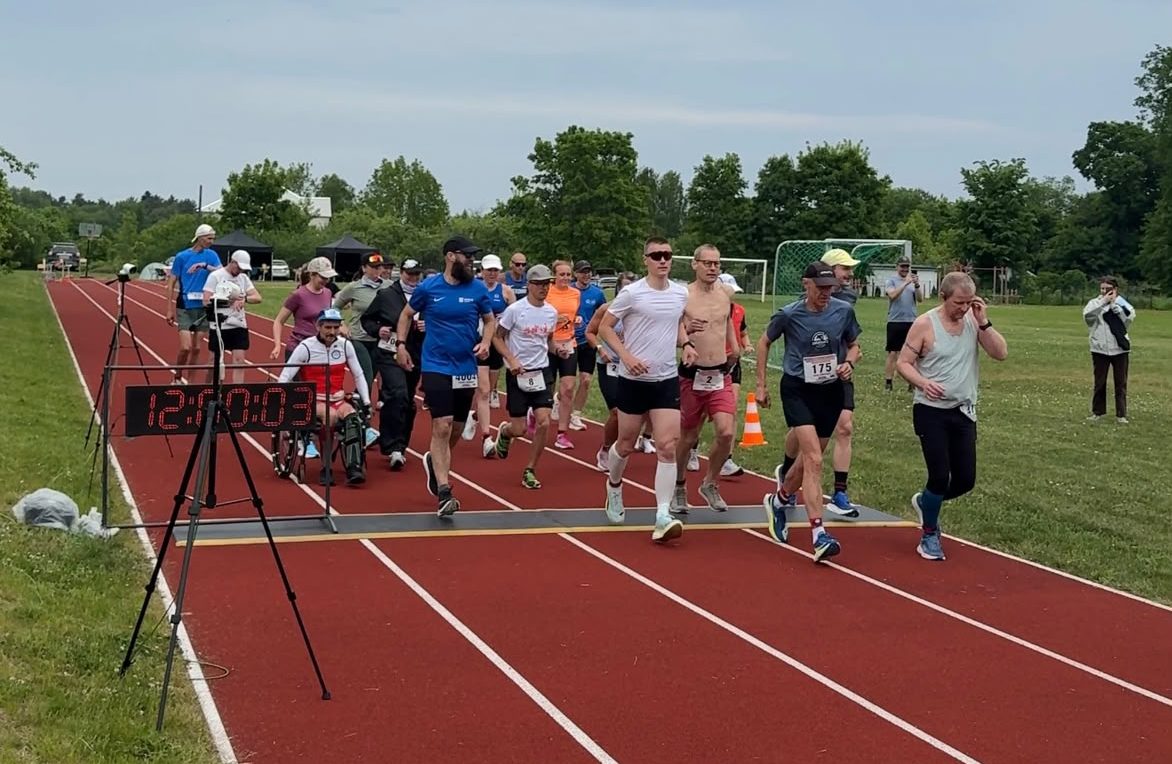
Simple on paper. Considerably less simple in practice. I registered for my first 24-hour race in November 2025, giving myself a nine month training block. Knowing I had never attempted anything remotely like it, I also started working with a professional coach. If I was going to spend an entire day running in circles, I wanted to make sure I was doing it properly.
Like anyone excited about a new challenge, I shared the news with friends and family. Their reactions were almost identical every time.
“So… you just run around in circles for a whole day?” – Yes.
“Without sleeping?” – Well… ideally.
“On purpose?” – Also yes.
Then came the question I never quite knew how to explain.
“But… why?”
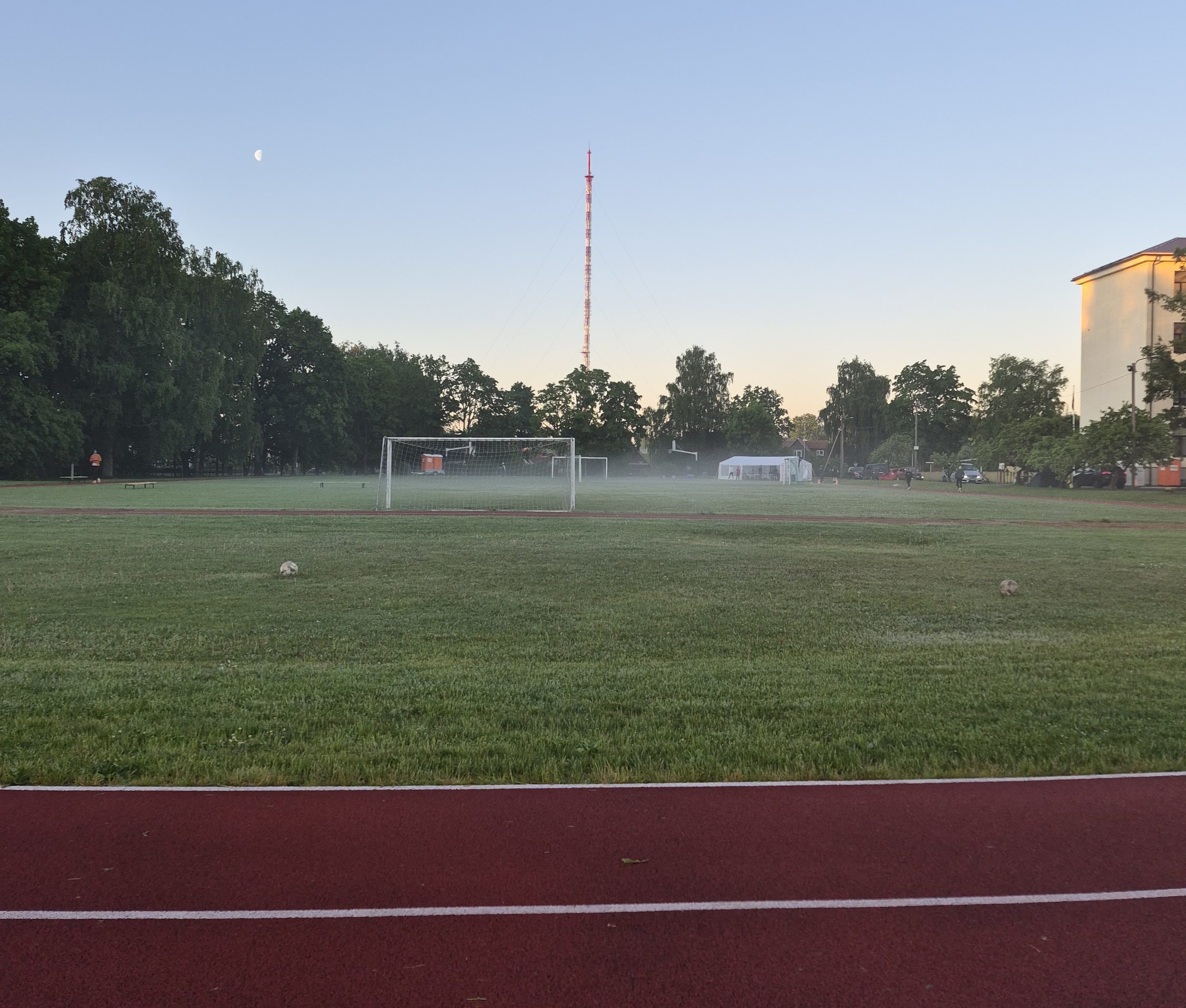
At the time, I never had a satisfying answer. To non-runners, a 24-hour race looks slightly crazy. Looking back, I think that’s because I was trying to explain a race I hadn’t yet experienced. On paper, it’s simply about covering as much distance as possible before the clock runs out. In reality, it becomes something much smaller and more immediate. Your world gradually shrinks to the next lap, the next drink, the next meal, and the next decision. You stop thinking in hours and start thinking in moments.
That was my biggest surprise. I had expected the challenge to be purely physical for nine months. My greatest fear was that my legs wouldn’t last 24 hours. Instead, I found myself making the same small decisions over and over. Should I eat now or after another lap? Keep running or walk for thirty seconds? Change into a dry shirt or wait? None of those choices seemed particularly important on its own, yet over the course of a full day and night, they became the race itself.
Ironically, I almost never got the chance to discover any of that. Six days before the race, I developed a fever accompanied by severe muscle, joint, and bone pain that left me barely able to get out of bed. It was the first time a race had brought me utter emotional devastation. All I could think was: nine months of discipline, and I might not even make it to the start line.
It’s strange how you hyper-focus on one event. Of course there would be other races, but this was my obsession, my 24-hour debut. I had thought about it every single day for nine months. And just like that, all that careful preparation, and emotional investment felt as though it could vanish overnight. To my surprise, by race morning I felt just well enough to stand on the start line. My coach’s advice was simple: forget ambitious goals, treat it as a learning experience, and stop once I reach 100 km. It wasn’t the race I had planned but in hindsight, it may have been exactly the race I needed to ease myself into the 24-hour runners’ world.
Over the following 24 hours, I learned far more than how many kilometres I could cover. Letting go of the distance allowed me to truly observe and focus on everything else that happens. I discovered why experienced ultra-runners obsess over pacing instead of speed, why plain pasta can taste like Michelin-star cuisine after midnight, and perhaps most importantly why so many runners willingly come back to do it all over again.
From Pedestrianism to the Modern 24-Hour Race
Although running for 24-hours may seem like a modern challenge, its origins stretch back more than two centuries. Today’s races evolved from the 18th- and 19th-century phenomenon of pedestrianism, a professional sport in which athletes competed in extraordinary walking and running contests for large cash prizes and the admiration of thousands of spectators.
One of the sport’s earliest legends was Captain Robert Barclay Allardice, who famously completed one mile every hour for 1,000 consecutive hours in 1809. Later stars such as Edward Payson Weston, Daniel O’Leary and Charles Rowell pushed endurance even further, with 24-hour performances becoming one of the defining tests of athletic stamina. Women’s pedestrianism also flourished, with athletes including Ada Anderson and Emma Sharp drawing enormous crowds while challenging the social expectations of their time.
At its peak, pedestrianism was one of the world’s most popular spectator sports. Arenas regularly filled with thousands of fans, newspapers devoted extensive coverage to the competitions, and leading athletes achieved celebrity status.
The modern 24-hour race emerged during the 1970s as ultra running began to develop into an organised international sport. In the decades that followed, the format was formalised by the International Association of Ultrarunners (IAU), establishing standard rules and official world championships. Since then, participation has grown steadily around the world, with more races, stronger competition and increasingly impressive performances each year.
Unlike many ultramarathons, a 24-hour race requires no mountains, technical trails or complicated navigation. Most events take place on a short loop or athletics track, making logistics surprisingly simple. The challenge lies in pacing, nutrition, sleep management and the mental resilience to keep moving long after the body wants to stop.
Few athletes have influenced the modern era more than Lithuania’s Aleksandr Sorokin, who rewrote the record books in 2022 by covering an astonishing 319.614 km at the IAU European 24-Hour Championships in Verona. Three years later, Great Britain’s Sarah Webster raised the women’s standard to new heights by setting a world record of 278.622 km at the 2025 IAU World Championships in Albi.
What began as Victorian entertainment has become one of endurance sport’s purest disciplines. The crowds may be smaller today than they were during the age of pedestrianism, but the objective remains exactly the same: keep moving until the clock reaches 24 hours.
What Actually Happens to Your Body During 24 Hours?
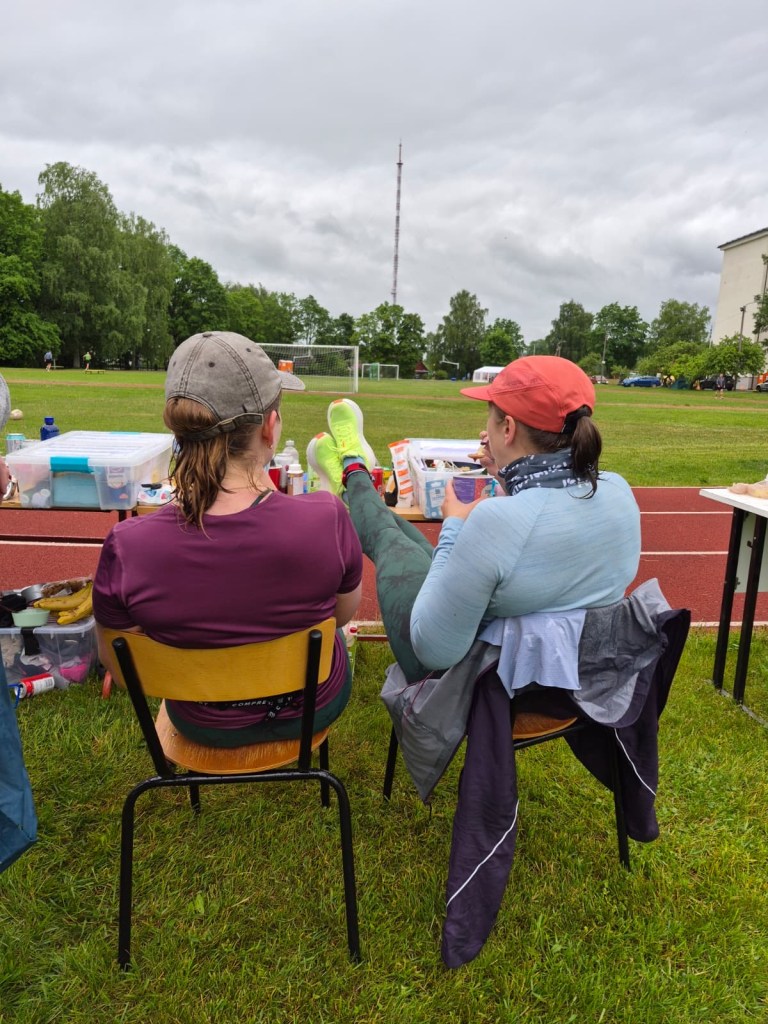
The first few hours feel relatively familiar. Your body relies heavily on stored carbohydrates (glycogen), your legs still feel fresh, and it’s surprisingly easy to get carried away. As those glycogen stores begin to run low, the body gradually shifts towards burning more fat for fuel. That transition isn’t always smooth, and many runners experience a sudden dip in energy before settling into a steadier rhythm.
For me, that happened somewhere around the nine-hour mark. The kilometres started accumulating slower than ever, I questioned what on earth I was doing there, and briefly wondered whether the whole idea had been a mistake. Then, almost as unexpectedly as it arrived, the feeling disappeared. I’d read countless times that hours 12 to 16 are supposed to be the hardest. Ironically, they became my favourite part of the race. Between hours 10 and 14 I found a rhythm, felt surprisingly strong, and genuinely enjoyed running in the dark.
A huge part of that was our night crew. Evelin was incredible. If I casually mentioned I needed something, by the next lap it had somehow magically appeared on the table. Every few minutes she greeted us with a smile, a little dance and enough enthusiasm to make you briefly forget you’d been running in circles for half a day. It’s amazing how much a tiny moment of positivity can lift your spirits at three o’clock in the morning.
I must take up a little space here to thank our crew: Rain, Silja and Evelin for making my first 24-hour race so special. They kept me fed, organised and moving when I didn’t particularly feel like doing any of those things. And Silja… I’m still sorry I made you help me wrestle my soaking wet sports bra off when my energy levels had completely disappeared. Some friendships are forged through shared adventures; ours apparently crossed that line somewhere during a clothes change in the front seat of the RAM.
That same clothes change also taught me another valuable lesson. In all the chaos, I completely forgot to put my timing chip back on. I happily ran several laps before realising I wasn’t hearing the reassuring beep each time I crossed the timing mat. The chip was still lying on the floor of the RAM, faithfully recording absolutely nothing while I was out there doing the hard work. Consider this a friendly reminder to every first-time runner: whenever you leave the course for a clothes change or toilet break, always check that your timing chip has made the journey back with you.
Nutrition quickly becomes its own endurance event. Elite runners consume hundreds of calories every hour through sports drinks, gels and real food, yet they still finish with a significant energy deficit. After enough hours, plain pasta, boiled potatoes or a cup of warm broth become infinitely more appealing than another overly sweet gel. And then there’s your stomach. Eventually it starts developing opinions of its own, usually at the least convenient moment.
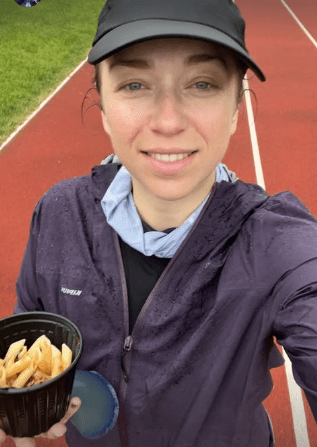
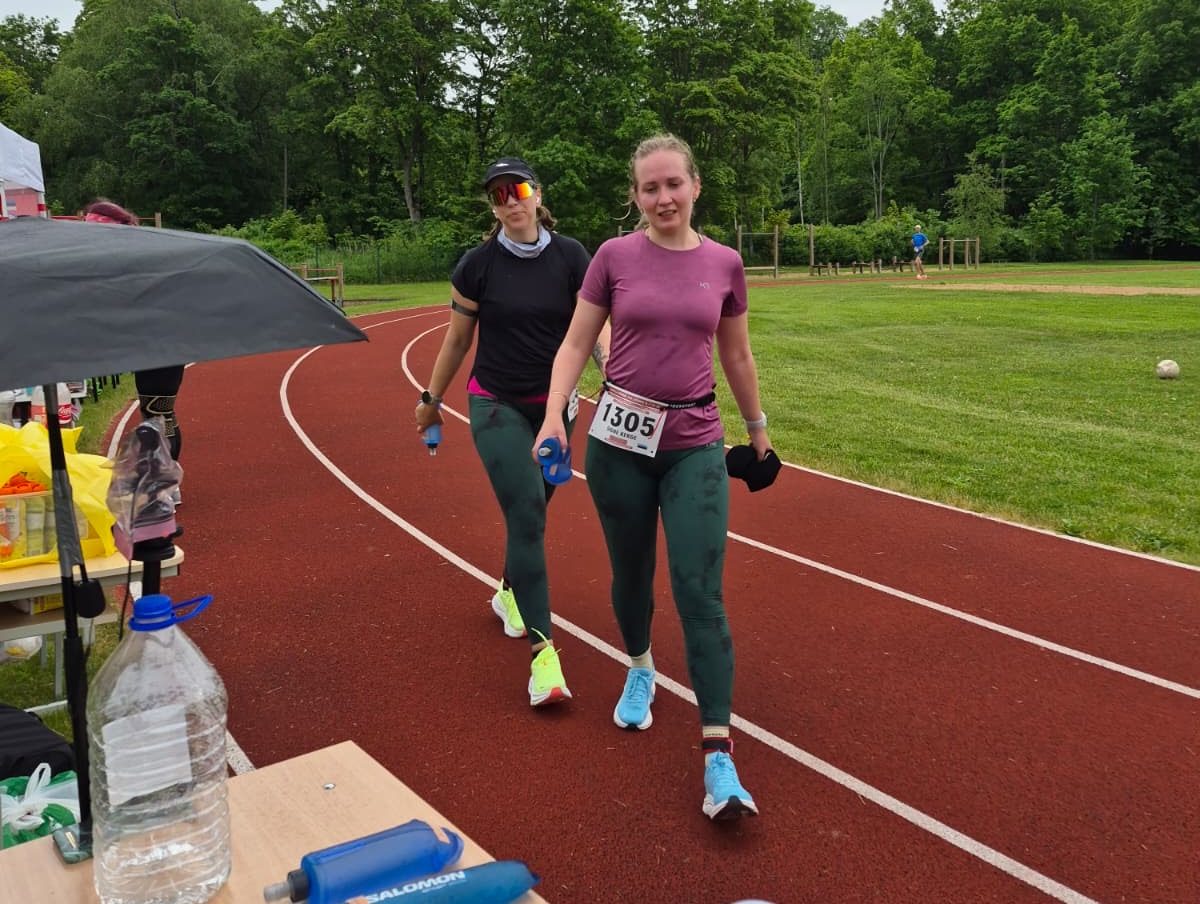
I was fortunate to avoid major stomach issues, but I saw how quickly they can derail a race. My best friend Signe Kerge was running alongside me and still managed to finish as the third Estonian woman, covering an incredible 160km. What makes that performance even more remarkable is that she spent the first few hours repeatedly vomiting and was barely able to move. Once her stomach finally settled, she somehow got back on her feet and kept going, even running intervals later in the race.
Your muscles tell a similar story. Every step creates tiny amounts of damage that gradually build throughout the day. Running form changes, stride length shortens, and walking stops feeling like failure and starts feeling like strategy. My original plan was to run for 27 minutes followed by 3 minutes of walking alongside Signe. The idea was to run our own pace but reunite every half hour to compare who felt more miserable after another hour of running in the rain, because of course it rained. Before long, the plan became 25 and 5, then even more walking as the hours passed. Those extra walking breaks weren’t a sign I was struggling; they were the reason I could keep moving.
The brain eventually joins the battle too. Sleep deprivation, fatigue and endless laps blur time, make simple maths surprisingly difficult and, for some runners, even lead to hallucinations. Thankfully, I escaped that particular milestone this time, although I have to admit I’m oddly looking forward to experiencing it one day. By the middle of the night, however, my decision-making skills had already become fairly questionable.
Recovery was perhaps my biggest surprise. Despite the enormous stress of a 24-hour race, many physiological markers return to normal relatively quickly when sleep, nutrition and recovery are prioritised. Muscles, however, often need much longer.
Three weeks later I still couldn’t run comfortably and had to rely on cycling and strength training instead. I wasn’t injured, running simply didn’t feel quite right yet, and I wanted to respect that rather than force my way back too soon. It was a good reminder that recovery is highly individual. Finishing a 24-hour race is only half the challenge. Giving your body the time it needs to recover is the other half.
Is a 24-Hour Race Safe?
One of the questions I was asked most often while preparing for my race wasn’t how far I hoped to run. It was whether running for 24-hours was actually safe. My mother struggled to understand a four-hour training run, so I’ll spare you her reaction when I announced I was planning to run for an entire day.
The answer is both simple and slightly frustrating: it depends. Like any endurance event, a 24-hour race places considerable stress on the body, but for runners who prepare properly, it is generally much safer than most people imagine. Serious complications are uncommon, although dehydration, overhydration, stomach problems, muscle damage and sleep deprivation are all genuine risks. That’s why experienced runners spend almost as much time practising nutrition and pacing as they do improving their fitness.
One of the most surprising things I discovered while researching the sport is that, unlike shorter races where raw speed often dominates, success over 24-hours rewards patience, experience and consistency. Studies have shown that many of the world’s best performances come from athletes in their forties, with plenty remaining highly competitive well into their fifties. As someone who only discovered running in my thirties, I found that strangely reassuring. It reminded me that in this sport, getting older doesn’t necessarily mean getting slower, it may just mean getting wiser.
That was probably the biggest lesson my own first race taught me. I had ambitious plans, only to have illness force me to abandon them before the race had even begun. Instead of chasing a number, I spent the day adapting to what my body was willing to give me and observing others. At the time, it felt disappointing. Looking back, it was probably the perfect introduction to 24-hour racing.
Perhaps that’s why this discipline fascinates me so much. From the outside, it looks extraordinary. In reality, it’s surprisingly ordinary. You spend an entire day solving one small problem after another, making hundreds of tiny decisions that eventually become the race itself. It’s a surprisingly good reminder that focusing on the next small step is often far more productive than worrying about the finish.

Like many first-time 24-hour runners, I crossed the finish line with far more questions than answers and was already searching online for my next race registration.
This article has been published also on: https://balticstride.com
 Running Over Hours
Leave a comment