I can’t clearly remember the first time I heard ultrarunning described as extreme. I’m fairly sure it started the usual way. You hit your 30s and start YouTube searches for marathons, training advice, running documentaries, and then suddenly ultramarathons appear. Cocodona. Badwater. Races that looked less like sport and more like endurance experiments on humans.
At first, I watched with detached disbelief. Well… only in America, I thought. Only there would people voluntarily sign up for something like this. Everything is bigger in America, why not the crazy running distances. It felt excessive. A bit theatrical. Entertaining enough to watch others do, but not something I took seriously.
That didn’t last.
The more I watched, the more that word, extreme, began to bother me. Not because the races were easy. Clearly they weren’t. But because the label felt lazy and off target.
Why was this automatically extreme? Who decided that? Was there a vote?
That question stayed with me. And eventually, it caught up to me one afternoon at my desk, halfway through another long workday and another meeting where you are online on teams but offline in your head.
Eight hours of sitting. Barely moving. Staring at a screen. No one questioning it. No one calling it dangerous or unbalanced, it is just the way it is.
So I asked myself something else instead: what actually feels more unnatural, moving for eight hours, or sitting still for eight hours?
If we are honest, both sit somewhere near the edge of what the body tolerates well. Both require adaptation. But only one of them gets treated as crazy behavior in modern society. Running for hours raises eyebrows. Sitting for hours is normal. Responsible, even, its what most people dream of after all, why they dig themselves knee deep into dept and go to uni for, study at a desk for hours to later sit at a desk for hours for a good pay day.
That disconnect is hard to ignore once you notice it.
From a biological standpoint, the human body is not built to avoid effort. It is built to sustain it.
Humans are unusually good at going long. We sweat efficiently. We stabilize our heads while running. Our tendons store and release energy. Our muscle composition favors endurance over explosive power. These are not accidental features. They are not optimized for comfort. They are optimized for persistence.
Evolutionary research suggests that endurance running played a role in early human survival, particularly through persistence hunting. Humans did not need to outrun animals quickly. They needed to outlast them. Follow them. Stay moving long after the initial chaos had passed.
Seen through that lens, long-distance running is not an innovation. It is a return.
Anyone who runs long enough notices something strange. The first kilometers can feel harder. Once the body warms up, breathing settles and movement becomes economical, the effort stops escalating. The body finds a rhythm. Not an easy one, but a sustainable one.
What tends to break first is not the body. It’s the idea that this should feel wrong.
Modern life places almost no physical demands on us, but constant psychological ones.
We sit for long stretches. We process information continuously. Stress becomes ambient. It has no clear beginning, no clear end. There is no physical resolution to it. You wake up to a screen and you go to bed to a screen, constantly thinking or looking at something or thinking of something.
Long-distance running does something different. It gives stress a container.
Effort builds. Discomfort appears. You deal with it. Then it passes. Hunger shows up. You manage it. Then it fades. There is a rhythm to the experience that modern stress rarely offers.
After long runs, many people feel oddly settled. Not euphoric. Not energized. Just quieter, still and calm within their own body. This is not a coincidence. Sustained movement followed by rest tells the nervous system that the situation has resolved. That nothing is chasing you anymore.
In that sense, running far is not dysregulating. It is corrective.
So why does ultrarunning still feel so intimidating?
Because it removes certainty.
Ultras involve not knowing how you will feel later. Not knowing exactly when discomfort will start or end. Not knowing whether motivation will still exist hours from now. The distance itself is not the threat. The lack of guarantees is.
But uncertainty was once the default. For most of human history, movement did not come with finish lines, medals or time estimates. You adjusted. You kept going. You trusted your body to figure things out along the way.
Experienced ultrarunners learn to do the same. They stop panicking when things feel bad early. They stop interpreting discomfort as failure. They learn that the body rarely quits without warning, and that most limits are more flexible than they look.
That kind of trust tends to spill over into the rest of life.

There is also a cultural discomfort at play.
We value speed. Efficiency. Visible output. Endurance is slow. Quiet. Repetitive. It does not perform well. There is nothing impressive about moving steadily for hours if your definition of impressive involves immediate results.
Yet endurance built everything we live on. Migration. Trade. Agriculture. Exploration. None of it was fast. All of it required patience.
When someone runs an ultramarathon today, it clashes with modern values. It cannot be optimized. It resists shortcuts. It takes the time it takes. Calling it extreme is easier than admitting that.
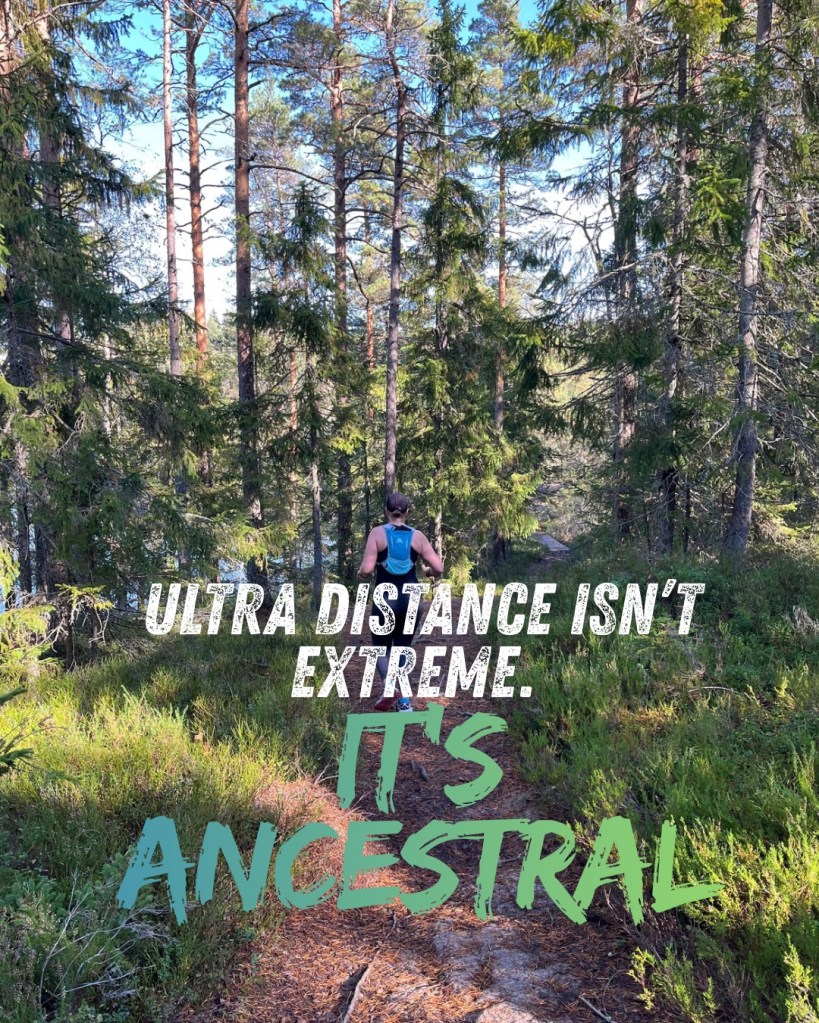
I no longer think of ultrarunning as extreme. I think of it as honest, a way to get to know yourself and the world around you.
It exposes how disconnected our daily lives have become from what our bodies handle best. It strips away constant stimulation and leaves you with effort, breath, and time. It asks for patience instead of intensity, and trust instead of control.
In a world where sitting still for eight hours is normal and moving for eight hours is suspicious, maybe the issue is not ultrarunning.
Maybe the problem is that endurance has become unfamiliar.
Long distances remind me that the human body is not meant to be preserved in comfort, but used. That endurance is not a rare talent, but a shared inheritance.
This article has been published by: https://balticstride.com/Baltic_Stride_1st_Edition.pdf


Leave a Reply